ResearchNurse and informaticist building the data infrastructure of learning health systems.
Dissertation Framing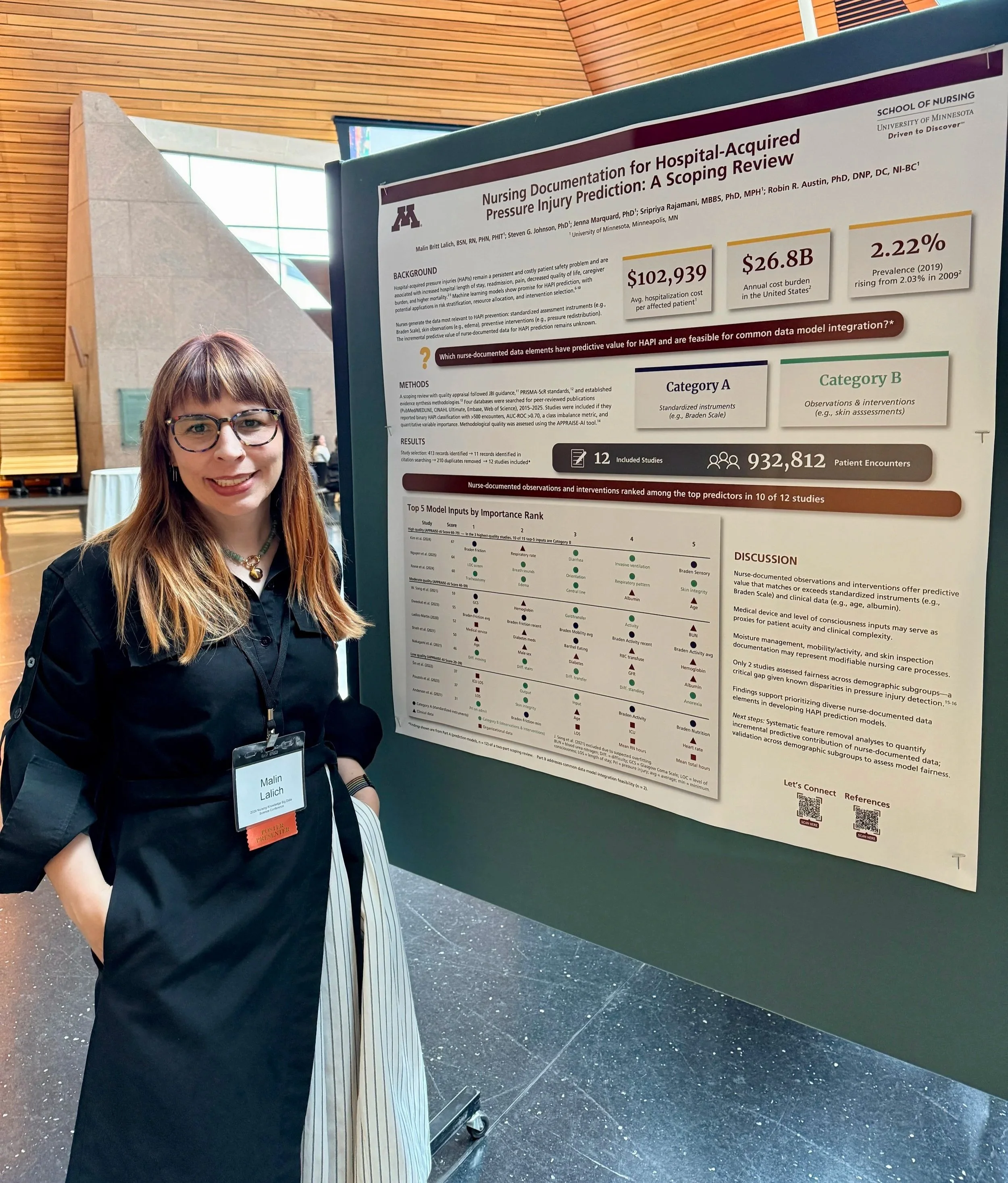
Common data models like OMOP, the shared infrastructure that lets clinical research replicate across institutions, are designed to hold a broad range of clinical data. Their buildouts to date have prioritized physician documentation: diagnoses, medications, and procedures. Nurse-documented observation has not yet been integrated at scale.
My dissertation builds a semi-automated pipeline that brings nurse-documented flowsheet data, one of the most frequent observation streams in the electronic health record, into OMOP. The pipeline uses computational methods to generate candidate concept mappings, which clinical and informatics experts then review. Hospital-acquired pressure injury prediction is the proof-of-concept.
Systematic feature-removal analyses on OMOP-integrated nursing data quantify what those data add to clinical prediction at multi-site scale. The pipeline is what other institutions can adopt with their own data; the prediction work is among the first worked examples of what nurse-documented observation can do once it is queryable alongside diagnoses, medications, and laboratory values.